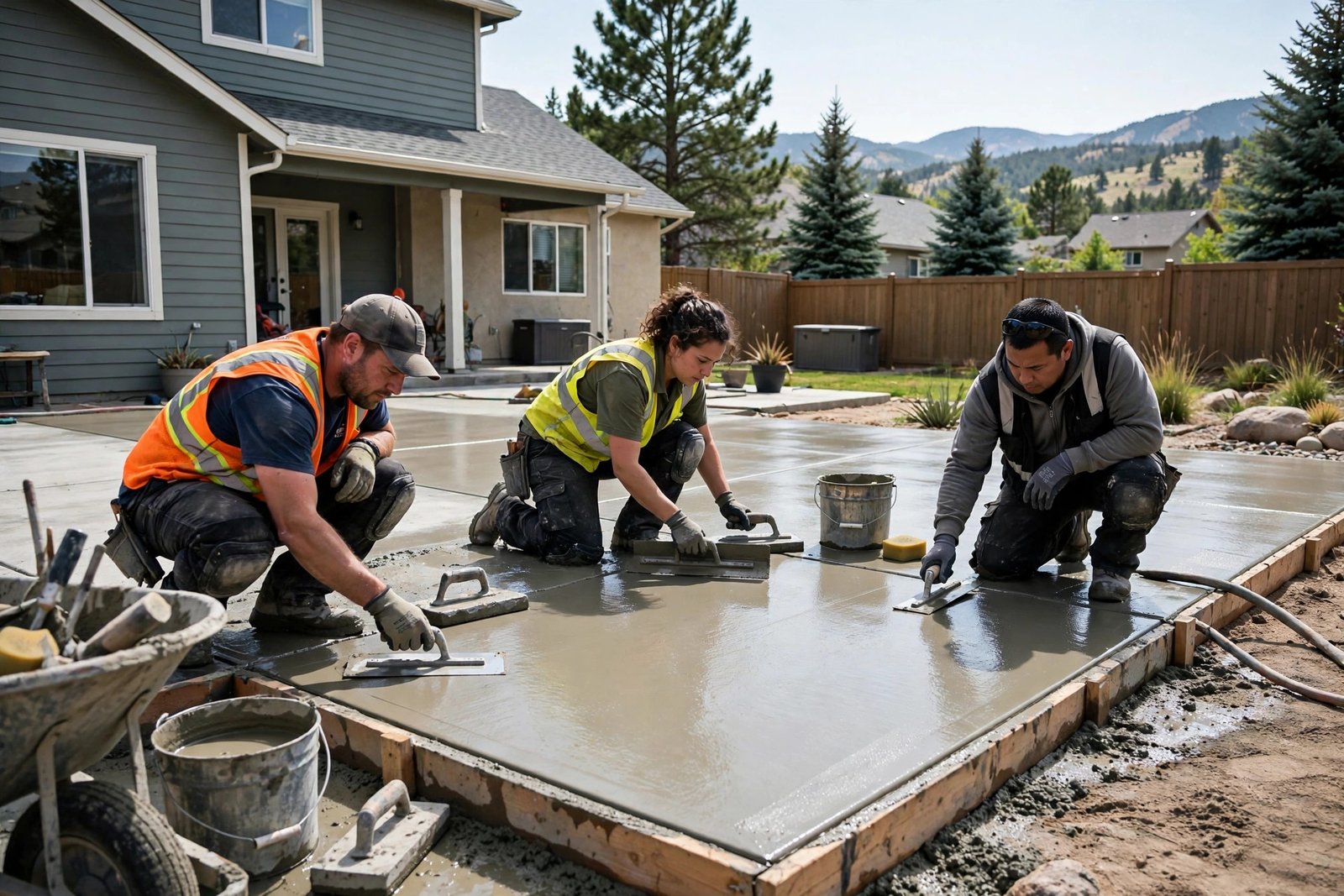
Every residential concrete service, under one roof
From the driveway to the backyard, residential concrete takes daily abuse in Colorado Springs — cars, snow, deicers, and freeze-thaw every winter. We pour every residential slab with air-entrained mix, compacted base, and correct joints, so it holds up for decades. Browse our residential services below, or tell us about your project for a free estimate.
Concrete Driveways
New driveways poured to handle Colorado winters — thick enough for your vehicles, graded to drain, and finished to grip.
Driveway Replacement
Tear-out and replacement of failed driveways — demo, haul-off, fresh base, and a new slab built to last.
Concrete Patios
Backyard patios in plain, textured, or decorative finishes — outdoor living space poured level and sealed for the seasons.
Sidewalks & Walkways
Front walks and garden paths poured flat, safe, and sloped to shed water away from your home.
Porches, Steps & Stairs
Porches, entry steps, and stairways with proper risers, treads, and rail-anchoring for safe entry in all weather.
Garage Floors & Slabs
Reinforced garage slabs that stand up to parked vehicles, workbenches, and daily use — with optional coatings.
Basement Floors
Basement slabs and refinished floors — smooth, level surfaces ready for living space or storage.
RV Parking Pads
Heavy-duty pads sized for RVs, trailers, and boats — thicker pours on compacted base to carry the load.
Pool Decks
Pool decks with slip-resistant texture and cool-touch options, graded so water runs away from the pool.
Outdoor Living Pads
Pads for hot tubs, fire pits, outdoor kitchens, and sheds — level, compacted support for heavy features.
Sport Courts
Basketball and multi-sport court slabs — flat, true surfaces that stay playable year after year.
Which residential concrete service do you actually need?
Most homeowners arrive with a symptom, not a service name: the driveway is crumbling, the back yard is mud, the front steps are tilting. Matching the symptom to the right service matters, because each one is engineered differently. A patio slab and an RV pad may look similar when they’re finished, but the pad is poured thicker, on a heavier base, with reinforcement sized for a ten-thousand-pound load — pour a patio-spec slab under an RV and you’ll be looking at cracked concrete within a couple of seasons.
Start with the driveway question, because it’s the most common. If you have no driveway at all — a gravel drive, a failing asphalt drive, or new construction — you need a new concrete driveway, designed from the subgrade up. If you already have concrete but it’s extensively cracked, settled in multiple places, or the surface is spalling across large areas, you’re usually past the point where spot repairs make sense, and driveway replacement (tear-out, fresh base, new slab) is the honest recommendation. Replacement is not a failure of the material; it’s what happens when the original base prep was thin, the drainage was wrong, or thirty years of freeze-thaw simply ran their course.
Patios and outdoor living pads answer different questions. A patio is living space — sized for furniture, a grill, foot traffic — typically poured four inches thick with a broom or decorative finish. An outdoor living pad is structural support for something heavy and specific: a hot tub, a swim spa, an outdoor kitchen with masonry, a shed. Hot tubs are the classic surprise — a filled spa can weigh several thousand pounds concentrated on a small footprint — so pads get extra thickness, denser reinforcement, and a base compacted to handle point loads without settling. If you’re planning both a patio and a hot tub pad, tell us during the estimate; pouring them in one mobilization keeps the grade, finish, and drainage consistent.
Sidewalks and walkways handle routes; porches, steps, and stairs handle grade changes. That distinction drives the engineering: a walk is a four-inch slab sloped gently to shed water, while steps need footings that reach below the frost line, consistent riser heights, and solid anchoring for handrails. Garage floors live in a harsher world than any other residential slab — hot tires, oil, road salt melting off vehicles all winter — so they get a denser finish and often a sealer or coating. Basement floors are the opposite environment: no vehicle loads, but moisture management matters, and the finish is usually smoother for future flooring. Pool decks need slip-resistant texture and grading that moves splash water away from the pool shell, and sport courts need the flattest, truest surface of all — small dips that you’d never notice on a driveway will send a basketball sideways.
One practical tip: concrete work has a mobilization cost — crew, equipment, and a concrete truck showing up — so bundling adjacent work into one project almost always costs less per square foot than doing it in two visits. A driveway plus the front walk, a patio plus the pad for the grill island, a garage floor plus the apron transition: if two projects touch each other, ask about combining them at the estimate.
The build standards behind every residential pour
Every residential slab we pour shares the same foundation of practices, because in Colorado Springs the climate punishes shortcuts. It starts below the concrete: excavation to a uniform subgrade, then four to six inches of compacted Class 6 road base, compacted in lifts with a plate compactor. The base is the part of the job you never see, and it’s the part that decides whether your slab is still flat in twenty years. Soft spots get dug out and replaced; the whole subgrade gets graded so water can’t pool underneath.
The concrete itself is an air-entrained mix, typically 4,000 psi for driveways and heavy-use slabs. Air entrainment means microscopic air bubbles are whipped into the mix — they give freezing water room to expand inside the concrete instead of blowing the surface apart. That is the single most important line item in a Colorado concrete spec. We also keep the water-cement ratio low; soupy, over-watered concrete is weaker, shrinks more, and scales faster, no matter what the ticket says the mix was.
Reinforcement goes on chairs or supports so it sits in the middle of the slab, not on the ground where it does nothing. Depending on the application we use #4 rebar on a grid or welded wire fabric, plus dowels tying into adjacent slabs like the garage floor. Control joints — the grooves you see in every sidewalk — are placed to decide in advance where the concrete cracks as it shrinks during curing. The rule of thumb is spacing of two to three times the slab thickness in inches, converted to feet: a four-inch slab gets joints roughly every eight to twelve feet. Isolation joints go where the slab meets the house, the garage, or any fixed structure, so the slab can move independently without transferring stress.
Drainage is designed, not hoped for. Flatwork gets a positive slope of about a quarter inch per foot away from the house, garage, and foundation. In a climate where snowmelt runs for weeks in spring, a slab that holds water against the foundation is a basement moisture problem waiting to happen. Finally, curing: Colorado’s dry air, wind, and altitude sun can pull moisture out of fresh concrete fast, so we cure with compounds or moisture retention and protect the slab during its vulnerable first days. Proper curing is the difference between concrete that reaches its design strength and concrete that dusts and scales early.
What drives the cost of residential concrete
Square footage is the starting point, but it’s far from the whole story. Shape complexity matters — a rectangular driveway is efficient; a patio with curves, borders, and multiple levels takes more forming labor. Demolition and haul-off is often the biggest variable: tearing out an old driveway, breaking it up, and trucking the rubble away can rival the cost of the new pour itself, and access determines whether that’s a quick skid-steer job or a long day of hand work through a narrow side yard.
Thickness and reinforcement step costs up in predictable ways: a four-inch patio slab uses less concrete and steel than a six-inch RV pad, and that shows up in the quote. Finish level matters too — a plain broom finish is the most economical; stamped, stained, or exposed-aggregate finishes add labor and materials. Site conditions are the wild card: a subgrade that’s soft, full of tree roots, or holding water needs remediation before anything gets poured, and drainage corrections — regrading, adding a drain, tying into a downspout system — are sometimes the most valuable part of the project. Right-of-way work, like the apron where your driveway meets the street, can involve city requirements that add steps. When we quote, the written scope spells out each of these so you can see exactly what your money is buying — and what you could adjust.
A realistic timeline, from first call to first use
A straightforward residential project moves faster than most homeowners expect, once it’s scheduled. The estimate visit usually takes thirty to sixty minutes: we measure, look at access, check drainage and the subgrade, talk through finishes, and leave you a written quote. During the busy season — roughly May through October in Colorado Springs — scheduling runs a few weeks out; in the shoulder seasons it’s often sooner. That’s the main reason to call early if you’re targeting a summer project.
On the work itself, most residential pours follow a familiar rhythm. Day one is prep: excavation, base placement and compaction, forming, and steel. The pour usually happens the next workday, and it’s the dramatic one — the truck arrives, the crew places, screeds, and finishes the concrete in a matter of hours. Then the quiet part: curing. You can typically walk on new flatwork within twenty-four to forty-eight hours, and drive on a new driveway after about seven days, depending on the mix and the weather. The concrete keeps gaining strength for roughly twenty-eight days, so the first month is for light treatment: no heavy equipment, no harsh deicers, and — through its first winter — we’d rather you shovel than salt it. We’ll give you exact timing for your specific mix at pour time.
Colorado Springs climate: what it means for your concrete
Colorado Springs sits at over six thousand feet, and the climate gives concrete a specific set of tests. The headline is freeze-thaw: we cycle across the freezing point dozens of times each winter, and every cycle is water expanding inside any pore it can reach. That’s why air entrainment, drainage, and sealing aren’t upgrades here — they’re the baseline. The second test is deicer salts. Magnesium chloride and calcium chloride, the workhorses of local snow and ice control, are chemically aggressive to concrete surfaces, especially young concrete. We advise keeping all deicers off new flatwork through its first winter, and using them sparingly afterward; sand for traction is the kinder option.
Soils add another local wrinkle. Parts of the Pikes Peak region sit on expansive clays that swell when wet and shrink when dry, which is exactly the kind of movement that cracks slabs. Good base prep and — critically — keeping water from ponding under or beside the slab are how you manage it. Drainage design on a Colorado Springs lot has to account for spring snowmelt that runs for weeks, summer cloudbursts that dump an inch of rain in twenty minutes, and the simple fact that water always finds the low spot. We grade every project so the low spot is somewhere harmless.
Altitude has quieter effects too. The sun is intense, which fades color and breaks down sealers faster than at sea level — decorative concrete here needs UV-stable color and a sealer maintenance rhythm. The air is dry and the wind is real, which makes proper curing during the first days non-negotiable. And north-facing slabs that never see winter sun will hold ice for months; where we can, we talk about sun exposure during layout, because a walk that melts itself on a February afternoon is worth more than any deicer.
Keeping it in good shape: a homeowner’s maintenance rhythm
Concrete is low-maintenance, not no-maintenance, and a little routine care buys a lot of years. The single highest-value habit is sealing: a quality penetrating sealer every two to three years keeps water and deicers out of the surface. You’ll know it’s time when water stops beading and starts soaking in. Keep the joints healthy — the sealant in control and isolation joints keeps water from working down to the base, where it causes the settlement and heaving that crack slabs.
Day to day, sweep or blow debris off so it doesn’t grind into the finish, and rinse off oil and automotive fluids before they stain — kitty litter or a dedicated degreaser handles fresh spills well. In winter, shovel with a plastic blade rather than a steel one, and skip the metal ice chipper; both scar the surface. Pile snow where the meltwater drains away from the slab, not against the foundation. Watch your downspouts: a surprising number of “concrete problems” are really “roof water dumping next to the slab” problems, and a ten-dollar extender can save a slab. And once a year, walk your concrete in spring and look for new cracks, settling, or spalling — catching movement early is what makes repairs small instead of big.
Residential concrete FAQ
Should I do my driveway and sidewalk in the same project?
How thick should a residential driveway be?
Can you pour concrete in winter?
Will new concrete match my existing concrete?
Do I need to be home while the work is happening?
How do you protect my lawn, landscaping, and sprinklers?
What happens if it rains on pour day?
Can I park an RV or trailer on a standard driveway?
How long does residential concrete last in Colorado Springs?
Do you handle permits or HOA approvals?
What’s the difference between curing and sealing?
Why did my neighbor’s concrete fail in five years while older driveways last decades?
What to expect when you call
The next step is simple: a conversation and a site visit. When you call (719) 555-0134 or email contact@coloradospringsconcreteworks.com, we’ll ask what you’re looking at — which areas, what’s wrong with the old concrete if there is any, what you want the finished space to do. That helps us show up prepared. At the site visit we measure everything, check access for equipment, look at drainage and the subgrade, talk through finishes and options, and answer every question you’ve got. Then you get a written quote with a clear scope: what we’re removing, what we’re pouring, how thick, what reinforcement, what finish. No pressure, no obligation, no disappearing after the handshake. If the quote makes sense, we pick a date and get you on the schedule — and that’s the whole process. The call is the easy part; the scheduling is the natural next step, so reach out whenever you’re ready.