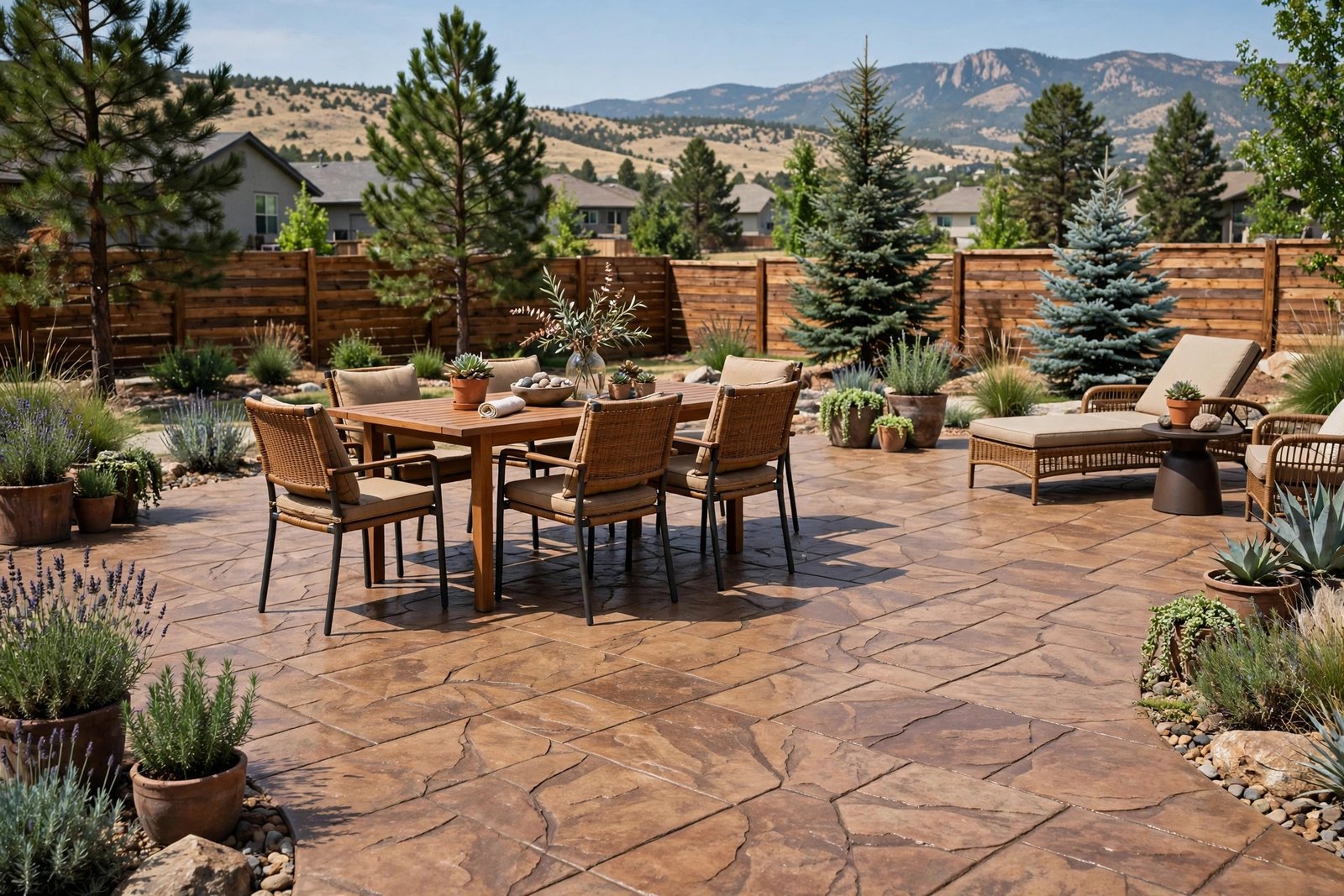
Concrete finishes that look like more
Concrete doesn’t have to look like concrete. Stamped patterns, exposed aggregate, stains, polish, and coatings give you the look of stone or tile with the durability and price of concrete — and they handle Colorado weather far better than pavers or wood. See what’s possible, then get a free estimate.
Stamped Concrete
The look of stone, slate, or brick pressed into fresh concrete — curb appeal without the mortar joints.
Exposed Aggregate
A textured, slip-resistant surface with natural stone beauty — great for driveways, patios, and pool decks.
Stained & Colored Concrete
Integral color, acid stains, and dyes that give plain concrete rich, permanent color and character.
Polished Concrete
Ground and polished floors with a low-maintenance sheen — popular for basements, shops, and showrooms.
Epoxy Coatings
Tough epoxy and polyaspartic coatings for garage floors and shops — chemical-resistant and easy to clean.
Overlays & Resurfacing
A fresh decorative surface over sound existing concrete — renew worn slabs without full replacement.
Choosing the right decorative treatment
Decorative concrete is a family of techniques, not a single product, and they differ in how they’re made, where they survive, and what they ask of you afterward. Here’s how we think through the choice with homeowners.
Stamped concrete presses patterns — ashlar slate, flagstone, brick, cobblestone — into fresh concrete, with color added integrally, as a surface-applied hardener, or both, and the pattern’s grout lines cut or formed in. It’s the best way to get a high-end stone look at concrete economics, and it shines on patios, walkways, and pool decks where the pattern reads as masonry. Outdoors in Colorado it needs what all exterior concrete needs — air-entrained mix, good base, drainage — plus a quality sealer maintained on schedule, because the textured surface holds water a little longer than a broom finish. Deep textures can hold ice in shaded spots, so we talk about sun exposure and texture depth during design. On driveways it works, but the pattern sees tire wear; choose patterns and colors that age gracefully under traffic.
Exposed aggregate is made by washing or retarding the surface paste so the decorative stone in the mix shows through. The result is naturally slip-resistant — the stone texture grips even when wet — which is why it’s a classic for pool decks, driveways on slopes, and walkways. It’s honest about what it is: real stone, real texture, no pattern pretending to be something else. Color comes from the aggregate itself, so it doesn’t fade the way surface color can, and it wears extremely well. The trade-off is comfort under bare feet (it’s pebbly) and snow shoveling (a deep exposure can catch a shovel blade) — practical points we raise before you commit.
Stained and colored concrete is about color rather than texture. Integral color mixes pigment through the whole slab so the color can’t wear off; acid stains react chemically with the concrete for variegated, mottled tones that look like natural stone; water-based stains and dyes offer a wider, more predictable palette. Staining is often applied to existing concrete in good condition — a way to transform a plain patio without replacing it — and it’s the most economical decorative upgrade per square foot. Outdoors, UV-stable color and a maintained sealer are non-negotiable, because Colorado’s altitude sun fades unprotected color steadily.
Polished concrete is an interior finish: the slab is ground with progressively finer diamond tooling until it takes a sheen, then densified and sealed. It’s the right answer for basements, shops, and showrooms — hard, low-maintenance, no coating to peel, and it makes a space feel finished without flooring. It is not an exterior finish for our climate; a polished surface outdoors is slippery when wet and the process assumes a protected environment. If you want decorative concrete outside and polished inside, that’s a common and sensible split.
Epoxy and polyaspartic coatings are resin systems applied over prepared concrete — most often garage floors and shops. Done right, with proper surface prep (diamond grinding, crack repair, moisture testing), they’re chemical-resistant, easy to clean, and available with decorative flake or metallic effects. The prep is the job: coatings fail from poor prep and moisture vapor, not from the resin itself. They’re interior or covered-exterior products; direct UV breaks down standard epoxies, which is why exterior or sun-exposed applications call for UV-stable topcoats.
Overlays and resurfacing put a new decorative skin — a polymer-modified cement topping, sometimes stampable or stainable — over existing concrete that’s structurally sound but cosmetically tired. It’s the renewal option: a fraction of replacement cost and time, and it opens the full decorative palette on a slab you already own. The hard rule is that the base slab must be sound — stable, no active settlement, no structural cracking. An overlay bonds to what’s there; it can’t fix what’s moving underneath. We’ll tell you straight whether your slab qualifies.
Where each finish belongs outdoors in Colorado
Freeze-thaw is the filter every exterior decorative choice has to pass. Stamped, exposed aggregate, and colored broom-finish concrete all pass it when they’re built on the standard exterior spec — air-entrained mix, compacted base, correct joints, drainage — because the decoration is in the concrete, not on it. That’s the key distinction: integral and penetrating treatments (integral color, stains that react with the surface, exposed stone) move with the slab and can’t delaminate. Film-forming products outdoors — paints, thin non-breathable coatings — are the ones that peel when moisture and frost get under them, which is why we steer exterior projects toward treatments that become part of the concrete.
Sun is the second filter. At six thousand feet, UV is intense, and it fades surface color and degrades sealers faster than at sea level. That doesn’t rule out colored concrete — it rules out unsealed colored concrete and bargain sealers. We use UV-stable color systems and quality sealers, and we tell you the reseal rhythm honestly: decorative exterior concrete is a maintained finish, like a wood deck, not a forget-it finish. Deicers are the third filter: stamped and colored surfaces are more visually affected by salt damage than plain concrete, so the “no deicers the first winter, sparingly after” rule matters doubly for decorative work. Sand for traction, shovel early, and let the sealer do its job.
The design process: color, pattern, and borders
Good decorative concrete is designed, not improvised on pour day. We start with the space: how big, how it’s used, what it connects to — the house’s stone or brick, the landscape palette, the style of the neighborhood. Then we narrow the field: pattern families for stamped work (large ashlar reads modern, flagstone reads rustic, brick reads traditional), aggregate choices for exposed work, color palettes for stained work. We work from physical samples and color charts, not screen images, because concrete color shifts with lighting, and we talk about how the color will weather — every exterior color mellows, and the design should assume it.
Borders and bands are the designer’s quiet tools. A contrasting border around a patio or walk — a different color, a stamped soldier course, an exposed-aggregate band — makes the whole project look intentional and custom for a modest addition in labor. Saw-cut patterns can add geometric detail to stained concrete without stamping. And restraint matters: one pattern and two colors is a design; four patterns and five colors is a sample board. We’ll give you an honest read on combinations, including which ones we’ve seen age well in Colorado Springs specifically.
How the work actually happens
Each technique has its own choreography. Stamped concrete is a race against the set: the concrete is placed, colored, and then stamped with large textured mats in sequence before it hardens — which is why stamping days are crew-heavy and weather-watched. There’s no pausing a stamp job halfway; the crew, the timing, and the release agent all have to be right. Exposed aggregate is about timing the wash: too early and you wash away too much paste, too late and the surface won’t expose. The crew reads the set like a baker reads dough.
Staining is slower and more forgiving — the concrete must be cured first (new slabs typically wait around a month), then cleaned, stained, neutralized where required, and sealed. Polishing is mechanical: heavy grinders, multiple passes with progressively finer diamonds, densifier applied mid-process, and a final seal. It’s dusty, loud, and methodical — and the result depends on the quality of the original slab, which is why we assess before promising a polish level. Coatings are prep-dominated: diamond grind, repair cracks and spalls, test for moisture vapor, then apply the resin system in its specified coats and cure windows. Overlays start with aggressive surface prep — the existing slab is cleaned, profiled, and primed — because the bond is everything; then the topping goes down, gets its texture or pattern, and is sealed. Every one of these lives or dies on preparation, which is why our quotes are specific about the prep steps, not just the pretty finish.
What drives the cost of decorative concrete
The finish is the headline variable. A stained existing patio is the most economical decorative project; a stamped new patio with integral color, borders, and steps costs more; a polished interior or a full flake epoxy system prices on its own scale. Beneath the finish, the standard drivers apply: square footage, demolition and replacement versus working with existing concrete, access, and site conditions. Decorative-specific adders include pattern complexity (more stamps, more detail, more crew time), color systems (integral color and high-end stains cost more than basic color), borders and bands, and steps or vertical faces, which are hand work.
Condition of existing concrete matters enormously for stains, coatings, and overlays: crack repair, patching, and surface prep are priced from what we find at the estimate, and a slab that needs extensive repair before it can be decorated may be honestly closer to replacement economics. Sealer quality is a line item worth asking about — the sealer is what protects the decoration, and it’s the wrong place to save money. Our quotes separate the build (slab, prep) from the decoration (color, pattern, sealer) so you can see both and adjust either.
Maintenance by finish
All exterior decorative concrete wants a maintained sealer — typically reapplied every two to three years, sooner on driveways and high-traffic areas. You’ll know it’s time when water stops beading. Stamped concrete’s texture holds a little dirt; a periodic wash with a garden hose and a soft brush keeps it crisp — skip the pressure washer on high, which can blast sealer off. Exposed aggregate is the lowest-maintenance of the exterior finishes: wash it, reseal it on schedule, and the stone does the rest. Stained concrete outdoors lives or dies by its sealer; keep the sealer fresh and the color stays rich.
Polished interiors want dust-mopping and occasional damp mopping with a neutral cleaner — no harsh acids, no wax. Epoxy and polyaspartic floors are the easiest of all: sweep, mop, done — just avoid dragging sharp metal and clean up harsh chemicals reasonably promptly. Overlays follow the maintenance of whatever finish they wear. And across all of them: felt pads under furniture, no metal shovels on decorative exteriors, and the same deicer restraint as plain concrete. Decorative concrete rewards a little care out of all proportion to the effort.
Decorative concrete FAQ
Will stamped concrete look fake?
Does decorative concrete cost more than plain concrete?
Can you stamp or stain my existing patio?
How slippery is decorative concrete when wet?
Will the color fade in the Colorado sun?
Can decorative concrete handle deicers?
What’s the difference between epoxy and polyaspartic coatings?
How long does an overlay last?
Can I get a decorative finish on a driveway that gets plowed or shoveled?
Do I need to seal decorative concrete, and how often?
Can you do a border or medallion without stamping the whole patio?
What if I don’t like the color once it’s done?
What to expect when you call
Decorative projects start with taste, so the first conversation is about what you’re picturing. When you call (719) 555-0134 or email contact@coloradospringsconcreteworks.com, tell us the space and the look you have in mind — photos of things you like help enormously, even if they’re from somewhere else. At the site visit we assess the space and, for existing concrete, whether it’s a candidate for staining, coating, or overlay; then we talk through options with real samples and honest guidance about what ages well here. Your written quote separates the build from the decoration — slab and prep on one side, color, pattern, and sealer on the other — so you can tune either. Then we schedule, and the fun part starts. If you’ve been saving inspiration photos, this is the call they’re for.